Friday, April 10, 2015

The Homestead Kitchen: Making Butter

My "new" old Dazey one gallon butter churn. This dates from about the 1920's, and I bought it on ebay. It doesn't appear to have gotten much use. The wood paddles were pristine, and all the workings were in excellent shape.  It is the original jar also, labeled "Dazey".  I love this thing.
 I thought you all might enjoy taking a trip back in time and seeing how an old fashioned hand butter churn works.  This was my first time using this churn.  I made butter before, using my electric blender.  This hand crank butter churn was easier, and I think, faster to use.  The total time (not counting washing up) was maybe 20-25 minutes, but only about 12-15 minutes of churning.

We are really blessed to have several local dairies which sell raw milk and raw cream.  So I bought two pints of cream for this small batch of butter.

 After maybe 7 or 8 minutes of easy churning, you can see that the cream is already beginning to separate.
 A few more minutes, and now it looks like butter and buttermilk.

 I poured off the buttermilk (if we had pigs, they would love this.)  I tried to make some "chicken cheese" by adding a bit of lemon and vinegar to this to curdle it, but it was still too thin.  Probably because I had also added a bit of the first wash water.  Anyway,  next time, I will know to curdle this before I add any more water. It is a healthful food for any animal. My dogs would have lapped it up for sure.
 After pouring off the buttermilk, I added some cold water to start washing the butter.  You want to get out every trace of the liquid, or the butter will go rancid in storage.  Wash, churn a couple times, pour that out, then do it again.  Use cold water for the rinse.
 After a couple rounds of rinsing, the butter was too hard for the churn to move it, so I transferred it to a bowl, and used this wooden spoon to work it, pressing out any more liquid. This is the last rinse with cold water, and you can see the water is clear.That's what you want to see... clear water, not milky.

Once the rinsing was done, I added salt to the butter, and put it in this half pint jar  to store in the freezer. By the way, butter doesn't expand when it freezes like a liquid might, so you can fill the container all the way to the top. The rest was put into another jar that I kept out for use right now.


Thursday, April 9, 2015

Mapping The Homestead


As Spring approaches (yes, I know it's going to come, even though we got MORE SNOW last night and everything is coated in ice), I am thinking more and more about how to plan what goes where, what stuff gets planted, and where, and how there are already areas of the property that are used daily, and some that are barely visited at all....  

Here's an aerial view, and I have done a preliminary job of mapping out how the property is used right now.  Some of this might change slightly, but, due to the slope of the land and access points, I think these "zones" are going to stay pretty much like this going forward.

Here's how I mapped.
Green- Zone 1.    These are areas that are visited every day, multiple times a day.  This is the core                                             homestead area.
Yellow- Zone 2 - This is the area that might need to be tended once or more per week. Right now, there are
                           the already existing fruit trees there, plus a sloped hillside that will be good for berry 
                           planting.  But, the point is, it's not an area I need to visit daily (at least, not once things are
                           established)
Red - Zone 3 -   This is primarily the back pastures.   I only need to go out there rarely.  Perhaps to cut if                               we decide to hay this field.... a few times a year.
Blue - Zone 4 -  This right now is an area that, while being close to the house, is a tangle of undergrowth on                             a steep slope from the front yard.  It is low priority for even developing, though it is                                       possible it could be planted, and then it might be more like a zone 1 or 2, depending on 
                         what gets planted there.
Purple - Zone 5 - This is our small patch of wild woodland.. it's not very big,  but it is completely                                             undeveloped, and it is on a steep slope downhill.  We will leave this as a buffer zone along                             the road, plus as an area for cutting some firewood.  There is also a small stream that runs                             through there.  
Orange lines.... these just show the typical traffic patterns coming and going from the house.  Knowing that these pathways are already established by habit, I wouldn't want to place a structure in the way of these paths, and any fencing should be planned to have gates where we would normally want to walk through. All just planning aids....

Mostly, you can see these zones are in a  kind of concentric circle around the house, which makes sense. The closer to the house, the easier the access. Its like in your kitchen...  you want the stuff you use every day (silverware, cups, plates, etc) in the most handy spot, and the stuff that you only need once in awhile can go in that bottom cabinet.
 Mapping these "zones" helps me to plan where I might want to plant certain things.  Fruit trees that don't need daily visits don't need to be in zone 1, but the main vegetable garden certainly does.  I would not want to walk down the hill to the woods area to have the vegetable garden.  Also, things like the garage and barn, and tractor shed will need to be easily accessed from the house, so of course they are in zone 1.  Animals that need daily care need to be in Zone 1.  If we had beef cattle out in the pasture, they are okay being in zone 3, because they don't necessarily have to tended daily during the grazing months.  During winter, they would be brought up to a barn nearer  the house, in which case, the zone 1 area might get extended to include that (as yet unbuilt) cow shed.  There is room for it.  
What you can't see from this picture is that our entire farm is on the shoulder of a hillside.  There is a flat area where the house, garage, and garden area are... everything else slopes up or down.  the horse paddock area is above the house... the pastures  and woods are all downhill... sometimes steeply.The area of  trees behind the chicken coop and garden  is probably 15 feet down, with an old stone retaining wall on part of it.   Without creating some walkways, or steps, down to those lower areas, it is not necessarily easy access.  Especially in winter with snow cover.  
I had considered incorporating ducks into the homestead, and they would be super happy down there in the bottom where zone 2 and zone 5 sort of meet, because the stream that runs down there would be a source of fresh, flowing water for them year round. However, not only is access hard because of the slope down from the house, but I can't even SEE that spot from, say, the kitchen.  Ducks need daily care, and certainly I need to be able to look out and see how they are doing. So, while that is a great spot for ducks because of the water, it is NOT a good spot for conveniently being able to take care of them. 

Well, anyway, this is the sort of thing that occupies my mind when I am not boiling sap or caring for chicks or cooking meals..... With spring's arrival, we will begin to get the garden soil prepared for planting, and making final plans for the barn build.  That's going to be a huge undertaking, so it's good to get a handle on how best to place things NOW, before we are in the midst of the big projects.

As a side note.. despite the fact that it did't get above freezing today, and we have an inch or so of ice covering everything, the rest of this week is supposed to warm up and even the nights will be above the freezing mark.  This may signal the end of sugar season.  As of right now, I have a little over 3 gallons of finished syrup. What a blessing.  And, maybe it's good that the season is about done, as I am getting close to being out of scrap wood to burn for evaporating all that sap!  Things have a way of working out.


Tuesday, April 7, 2015

Mixed Bag

Who Could Resist This Face?  

Today was a sort of mish-mash of various tasks, overlapped as much as possible.

For starters, there is still sap to boil.  (This might be the last good week of sugar season, though, so I am not minding it).

The improved, repaired chick greenhouse.  Strapping nailed along the top and sides should keep the plastic secured now.

There was another necessary task, also outside.  A severe windstorm, with 40 mph gusts, pretty much wrecked the chick's greenhouse quarters.  There was nothing to do but take it down and wait for the winds to subside so repairs could be made.  Some extra wood strapping secured the plastic (which was not ruined, thank goodness) and so now the greenhouse is up and functioning again, and the chicks have more space.  They have had to live in the chicken coop since Saturday.

So it was a matter of  working on the greenhouse and monitoring the sap at the same time.  I also was able to plant a few more onion seeds for the cold frames, haul in some sacks of feed, and split the rest of the scrap wood for burning.

The girls found this southeast facing slope that is now bare of snow.

Cabbages are up!

More Onions!  A mix of red, yellow spanish, and sweet. These are out in the cold frame.


They say we might get snow again overnight.  Thats ok, I know it wont last... the spring sun is strong.

One of the things I always do is cook large batches of beans, of various kinds, and freeze them in dinner size portions.  So on busy days like this when I might not be able to cook an elaborate dinner, we can cook some rice , thaw the beans, warm up some tortillas and have a nice simple, but hearty meal that doesnt require much work .  As a special treat, tonight we will add some roasted green chiles that we found in the store last weekend. Yum!

Monday, April 6, 2015

Meeting the Expectations of the Land

"Meeting the expectations of the land."

That phrase, used by a blogger whose homestead blog I follow, got me to thinking.  We are really only stewards of the land.  We don't own it. If anything, it owns us.  That is, if we choose to labor in cooperation with the seasons and the soil.  Homesteading isn't about controlling the land, it is about living in harmony with it as much as possible. That's the only way to create a sustainable lifestyle.
Stewarding means honoring the systems that are involved in the natural processes.
A friend once said, "once you place a pen around an animal, you become responsible to provide everything that animal needs to flourish".  In other words, their health, happiness, and natural instincts need to be recognized and provided for.
The same is true for the land.   Building soil, and the natural microbial life within it that are vital for growing things, has nothing to do with sprinkling some commercial fertilizer on top of the garden.  There is so much more care and cooperation that is needed. In reality, we don't grow crops. We (should) grow soil.  
Part of the stewardship  is also accepting the seasons and what they give.. as well as what they demand.

 Right now, with sugar season in full swing,  time has to be taken to collect and boil and preserve the precious maple syrup.  
Convenience has little to do with it.  Other chores don't go away, but still time has to be found to manage the sugaring.  I accept that, and is why I was outside boiling until  2:00 am this morning. 
And up at 6:45 am because there are animals that depend on me.  Not every day is like this, of course, but some are and that's the reality.  


The garden area is finally beginning to peek through the snow cover

Another long night of boiling sap last night will net maybe a gallon of finished syrup.
The boiling was cut short by lack of scrap wood that is cut to size. This is all I have left.
The chicks must live in the big coop for now, after a windstorm destroyed their greenhouse on Saturday.
Finishing last night's sap in the kitchen..

So today will be a full day, with the reward at the end being more finished syrup, healthy growing chicks, happy chickens, maybe some seeds planted,  laundry done, and  homemade wine bottled. (Oh yeah, that is something that DID have to take a back seat while everything else demanded my time.)
Somewhere in there supper will be prepared, and husbands welcomed home at the end of the day, to share a fire-side evening together. Life is good.

Saturday, April 4, 2015

Patience.... and Olive Oil

Spotty and slow germination of all the peppers.  I re-planted a few of the empty pots.

Tomatoes are looking happy. Celery (in front) are tiny. They take awhile to get going.

Wallpaper removal.  Slow and tedious.
Some things just require patience.  Seeds emerging from soil, snow slowly melting, winter ever so slightly turning to spring. Each in its own time, and on its own terms.  There is nothing I can do to control how it all happens.  I can only do my part-plant the seeds, give them warmth and light  and water -and wait.

Yesterday's task was working on removing the old wallpaper from the living room.  Old wallpaper covering even older real plaster walls doesnt come off easily.  It is tedious work, and slow. But it does eventually get done.  This is a lesson I have learned from competing in very long endurance races.  Just keep movong forward, one step at a time, slow, incremental progress.  I called upon that endurance mindset yesterday, and just kept plugging away at the wallpaper.   It will get done.  
Being able to put a fresh coat of new paint color on these old walls will be the reward .


Many of you probably already know that most, yes, that's right, MOST, of the extra virgin olive oil sold in your local supermarket, is NOT actually extra virgin olive oil.  There is an incredible amount of money in olive oil, and so manufacturers have adulterated the expensive EVOO (extra vrigin olive oil) by adding lesser grade filler oils.  These fraudulently labeled bottles of oil are everywhere on your grocery store shelves. And since the health conscious person is buying EVOO for its health benfits, it is indeed frustrating and maddening to find that what you have been paying premium price for, is not actually what you are getting.
Fortunately, there ARE still some honest oils out there.  Here is a link to a list of brands that tested out as the real deal. And, happily, many of them are not expensive!

http://www.truthinoliveoil.com/2012/09/toms-supermarket-picks-quality-oils-good-prices

And here is a link for a story on what to look for when buying olive oil to get the best quality. It gives some helpful label-reading tips to try to find good oil anywhere.

http://www.theguardian.com/lifeandstyle/2012/jan/04/olive-oil-real-thing

Thursday, April 2, 2015

Thaw


Bare patches offer chicken delights

The girls in some newly thawed garden area. Eat all those weed seeds, girls!


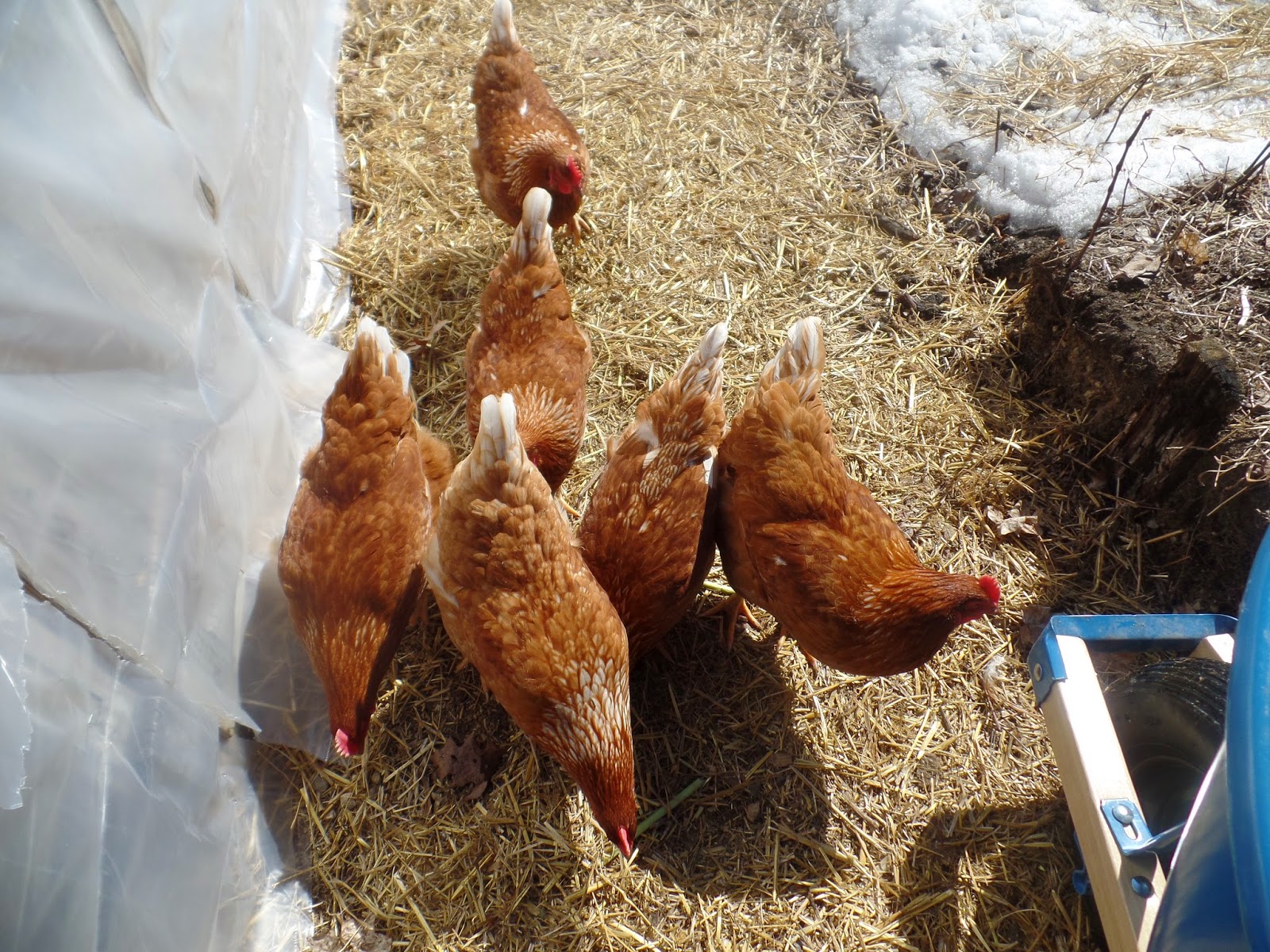
The last couple of days with above freezing temperatures have precipitated lots of thawing.  I see bare patches of ground appearing here and there. The chickens are discovering little bits of green weeds poking up, or bits of weed seeds, and who knows what else?  I can barely chase them into the coop at night, they are enjoying their expanded territory so much.


The baby chicks did alright last night in the big coop with their heater. Even though it was only 22 last night, they seemed fine this morning.  Better than me, probably, because I hardly slept worrying about them.  When I released them into their "chicken greenhouse" it was only 33 in there, but quickly warmed up and they really didn't seem to mind. I have to move the heater units back and forth morning and night, between their nighttime crate and daytime run.  Pretty soon it will be warm enough that this won't be necessary, and they are so happy in their new expanded living quarters, that I won't mind the bit of extra work until things really warm up.


And, a totally unrelated bit of fun news.... Our plein air painting group has an exhibit in a beautiful old Inn up north in the mountains here.  Our news channel did a story about the Inn, and one of my paintings showed up on TV, just in the background.. but it was still neat seeing it on TV.


Wednesday, April 1, 2015

Chick Moving Day


Too big for their old home now!
 So, today is a big milestone for the chicks.  Today, they moved outside into the big chicken pen.  Of course, some adjustments had to be made.  It is far too cold for them.
So I spent a few hours yesterday covering the run with plastic sheeting. And by the way, that is hard to do on a windy day, when you are doing it yourself.   Anyway, doing this created basically a greenhouse inside the run.  Though it is cold and windy outside today, inside that chick greenhouse it is very nice and toasty.

How toasty? It is 43F outside. It is 90F inside.


 After creating a wind and waterproof covering, I took lots of straw and laid that down on the ground. The ground is still frozen and cold, and there is even still snow in one corner, but this thick layer of straw will keep the chicks well insulated from the wet cold ground. Plus it is a healthier environment than bare dirt.

Into the moving bix, chicks!
Moving Box

Moving Truck, sort of.

The chick greenhouse... 9 x 20 feet, exponentially bigger than their crate. 

the big hens come to see what the fuss is all about.


Day 21A  Into the New Pen


They were wary at first, but it didn't take too long for them to all come out of the box and take a look around. They all stuck together, moving as one big clump o' chicks.... it reminded me of watching 6 year olds play soccer. 


I went back later to check on them, and they were feeling much more at home, exploring and generally just acting like chickens!  The noise in the background is the plastic sheeting blowing around a bit in the wind.  It is so toasty in here I want to take a nap on the clean straw... 

Day 21 B  The New Digs are Cool, uh, Warm


So, I am not totally decided where I want to put them at night. They have the heat lamp here, and the run wont get as cold even at night for quite awhile because of the residual heat gathered during the day.
However, I am a little concerned about some predator being able to dig under the doorway... it's pretty secure, but a determind raccoon can manage to get in just about anything.  So the other option is to herd them all back into the crate at night, inside the larger chicken coop. It's more secure, even if it might be a bit colder. They will have a heat lamp there as well,,. decisions, decisions.